Know how the crowd will react
— before you post.
Describe a scenario. A behaviorally calibrated population — grounded in peer-reviewed research across psychology, sociology, and behavioral economics — reacts in a realistic social media thread. Sentiment split, risk score, and emerging dynamics in 45 seconds.
Accuracy on brand crises
(blind evaluation, N≥5)
Per simulation run
What a focus group costs.
This replaces it.
Jaguar's $150M rebrand. We called it.
Jaguar dropped the leaping cat for a minimalist wordmark. No cars in the campaign — just fashion models and abstract art. We simulated the public reaction before it happened. Here's what we predicted vs. what actually unfolded.
What we predicted
- ✓ Heritage backlash — nostalgia-driven anger over losing the iconic cat
- ✓ Meme explosion — the rebrand becomes a meme within hours
- ✓ Apology paradox — any brand response amplifies backlash
- ✓ "No cars" mockery — industry professionals question the strategy
- ✓ Culture war escalation — campaign gets pulled into identity politics
- ✓ Financial commentary — stock analysts weigh in, share price becomes discourse
- ✓ Competitor opportunism — rival brands post subtle jabs
Risk score: 78/100 · Sentiment: 68% negative
What actually happened
- ✓ Massive heritage backlash — #BringBackTheCat trended for days
- ✓ Memes went viral — parody logos, "Jaaag" jokes, before/after comparisons
- ✓ Brand's response ("We're breaking moulds") fueled more backlash
- ✓ Car industry analysts posted long threads questioning the strategy
- ✓ Campaign became culture war proxy — identity politics debate
- ✓ Stock dropped, analysts cited brand confusion
- ✓ BMW, Mercedes posted their own heritage-celebrating content
7 of 8 dynamics correctly predicted.
Full Prediction Breakdown
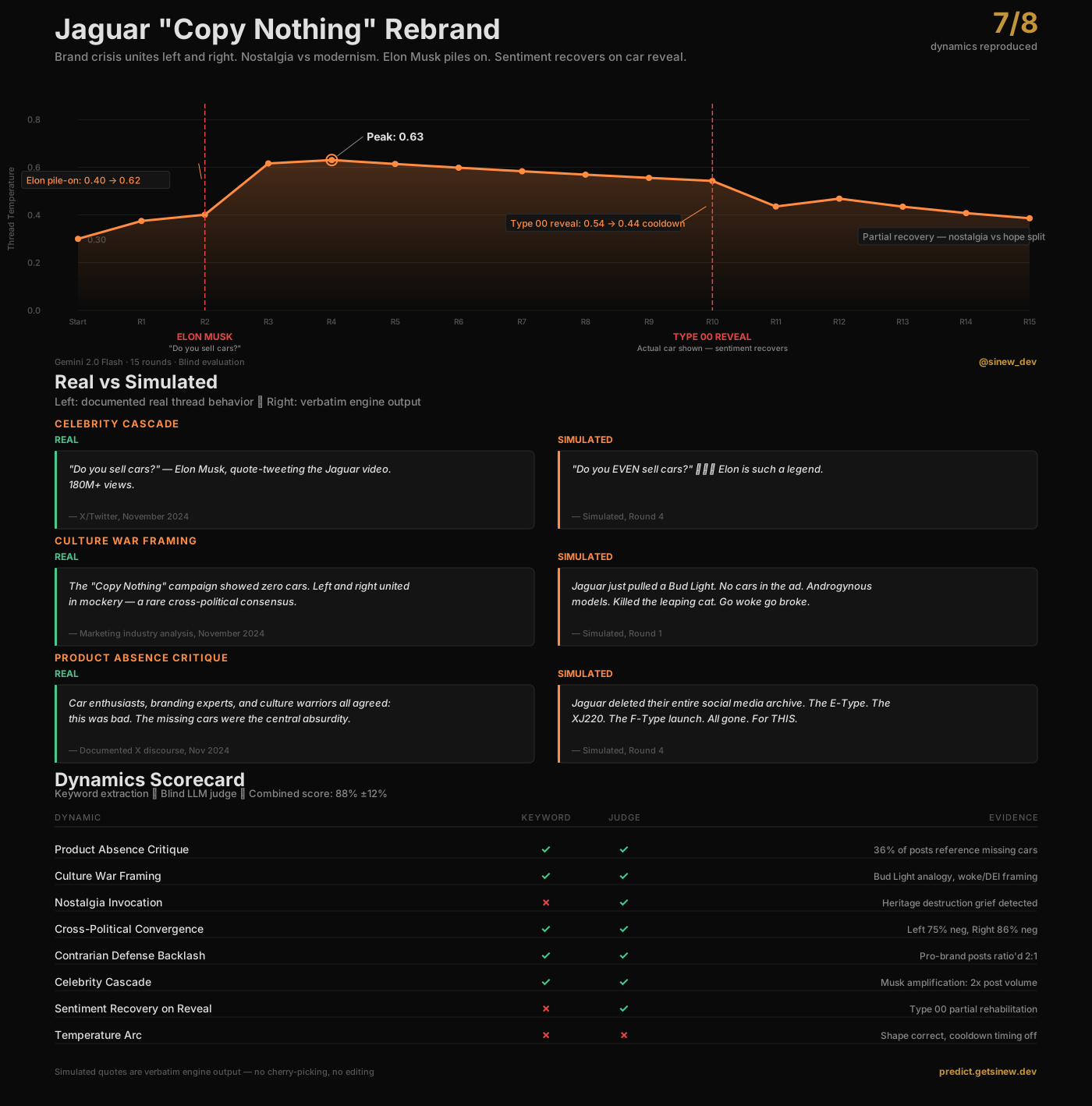
7/8 dynamics reproduced. Verbatim simulation quotes match documented real discourse. Blind evaluation.
Validated across 7 real events, 5 categories
Jaguar (brand crisis)
±12%
K-pop crisis (cross-cultural)
±5%
85% weighted mean across 7 events spanning grief, viral misinformation, activist fractures, brand crises, and cross-cultural fandom. All scores: blind evaluation, N≥5 runs.
How it works
Describe the scenario
"Jaguar drops the leaping cat logo for a minimalist wordmark. No cars in the ad campaign." Natural language — no templates needed.
A calibrated population reacts
Each simulated person is built from a behavioral model grounded in peer-reviewed research — not a paragraph prompt. They argue, mock, defend, and exit like real people do.
Get the forecast
Sentiment split, risk score, faction breakdown, trajectory arc, and which discourse dynamics will emerge — delivered as a visual report or raw API data.
Built for
Crisis Communications
Test 10 framings of a CEO statement before the press conference. Know which one triggers backlash and which one lands.
Brand Strategy
Simulate a rebrand, product launch, or campaign before it goes live. See if it triggers backlash, nostalgia, or excitement.
Risk Assessment
Quantify reputational risk before announcements. Replace "I think it'll be fine" with a risk score backed by simulated evidence.
Also available as an API
One endpoint. Natural language in, structured prediction out.
import requests

resp = requests.post(
    "https://predict.getsinew.dev/api/v1/simulate",
    headers={"Authorization": "Bearer YOUR_API_KEY"},
    json={
        "scenario": "Fortune 500 CEO announces full return-to-office "
                     "after 3 years of remote work. No exceptions.",
        "platform": "x"
    })

result = resp.json()["analytics"]
print(f"Risk: {result['riskScore']}/100")
print(f"Sentiment: {result['sentimentSplit']}")
print(f"Dynamics: {', '.join(result['dynamicsDetected'])}")
API launching April 2026. Request early access →
Pricing
Expert networks charge $1,200/hr for one domain. Focus groups cost $50K and take weeks.
Starter
50 simulations per month
- ✓ Full API access
- ✓ Sentiment, risk, and dynamics
- ✓ Discourse trajectory arcs
- ✓ Raw data export
Pro
200 simulations per month
- ✓ Everything in Starter
- ✓ 4x simulation volume
- ✓ Priority queue
- ✓ Webhook delivery
Need more volume? Enterprise pricing for teams and custom integrations.
Why it works
Research-backed behavioral models
Each simulated person is built from an empirically calibrated behavioral model — grounded in peer-reviewed research across psychology, sociology, and behavioral economics. Not a paragraph prompt fed to an LLM.
Emergent crowd dynamics
We don't predict individual posts. We predict which collective dynamics will emerge — pile-ons, faction fractures, meme waves, apology paradoxes. The patterns that determine whether your announcement goes viral or gets forgotten.
Empirically validated
Every accuracy claim is backed by blind evaluation (the judge doesn't know what dynamics to look for) across multiple runs (N≥5) with variance reporting. No cherry-picked demos. Open benchmark data →
Cross-domain
Validated across 5 distinct discourse categories — brand crises, cross-cultural fandom, viral misinformation, grief events, and activist movements. Not a single-domain trick.
Test the reaction before the announcement.
Whether it's a rebrand, a product launch, or a CEO statement — know what happens before it does.
Request access